

See One, Do One, Teach One: Sales Still Trains Like It's 1904
Sales onboarding still runs on surgery's oldest apprenticeship rule. Surgery measured who paid for that learning curve, then moved it into the simulator. Sales can too.
Here is a sales onboarding plan you have almost certainly seen, and possibly written.
Week one, the new hire shadows calls. Week two, they run a call while a senior rep listens in. By month three, a newer hire is shadowing them.
Surgeons have a name for this. They call it see one, do one, teach one, and they have been arguing about it for most of a century. The phrase is usually pinned on William Stewart Halsted, who became the first chief of surgery at Johns Hopkins in 1890 and built the residency model that most of American surgery copied. In 1904 he set out his thinking in an address called The Training of the Surgeon. Nobody has found the exact words "see one, do one, teach one" in his writing, but the idea is his: learn by watching a master, then by doing, under supervision, with a little more responsibility each time.
It is a good model. It produced generations of great surgeons, and it has produced generations of great salespeople. It has one hidden cost, and in surgery, somebody finally measured it.
Revyn puts a rep in front of a live AI buyer that objects, then scores the call.
Try a practice call#The first thirteen patients
In the late 1980s a new operation arrived. Laparoscopic cholecystectomy, keyhole removal of the gallbladder, replaced a large open incision with a few small ports and a camera. Patients loved it. Surgeons had to learn it fast, mostly while already in practice.
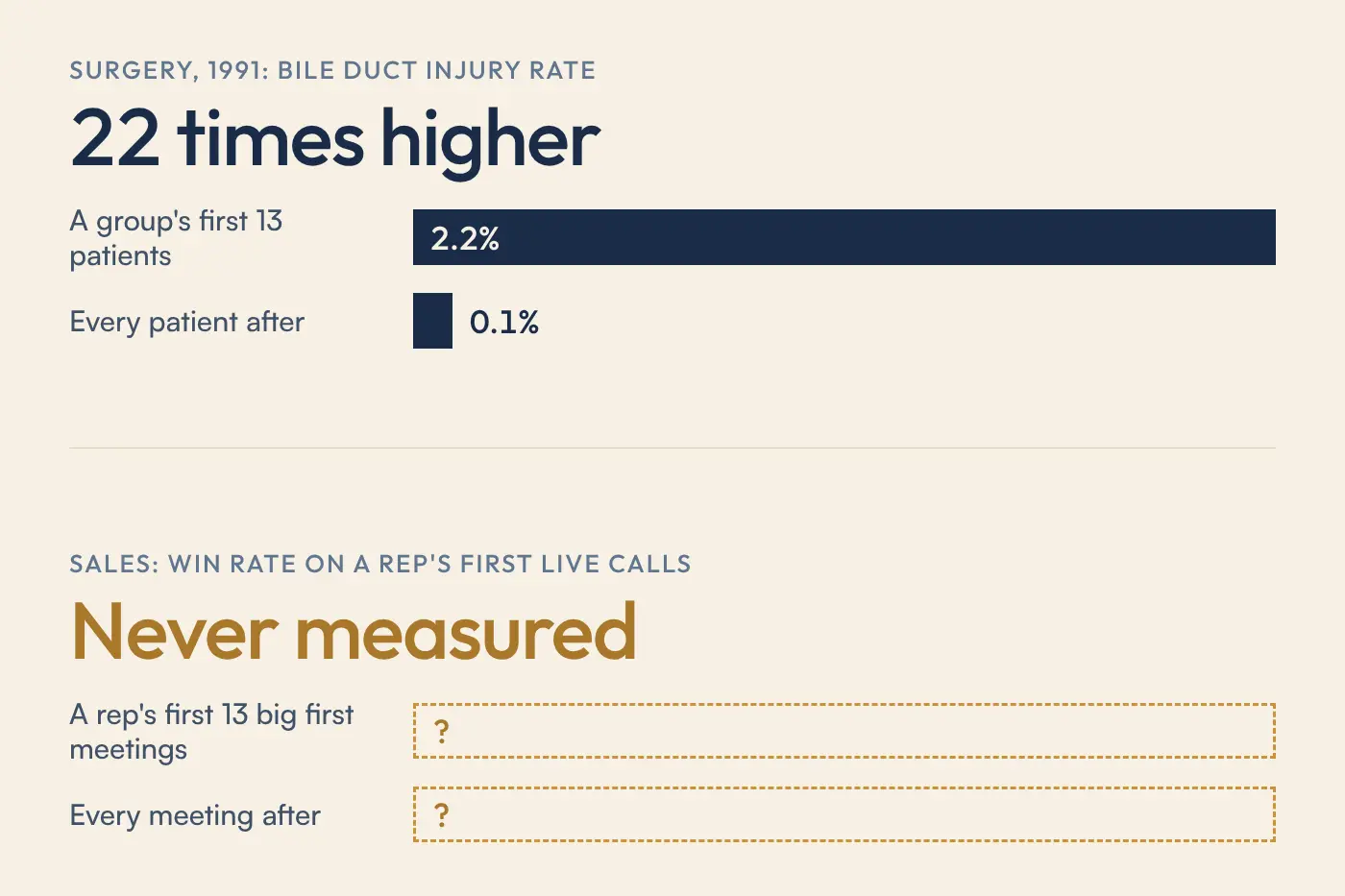
In April 1991 a group of surgeons called the Southern Surgeons Club published what happened in the New England Journal of Medicine. They had tracked 1,518 operations. Overall the new procedure did well. But one number stood out. Injury to the bile duct, the serious complication everyone feared, happened in 2.2% of the first 13 patients each surgical group operated on. For every patient after that, it was 0.1%.
That is a 22-fold difference, and it had nothing to do with the patients. It was the surgeon's learning curve, and the people underneath it were paying for it.
Four years later the same group came back with more data: 55 surgeons and 8,839 operations. Their 1995 analysis opens with a sentence that should make any sales leader wince: "The use of laparoscopic surgical procedures without previous training has grown rapidly." Ninety percent of bile duct injuries happened within a surgeon's first 30 cases. Their model put the chance of an injury at 1.7% on a surgeon's first case and 0.17% by the fiftieth. The only factor that predicted a bad outcome was experience with the procedure.
Their recommendation was blunt. Institutions "might consider requiring surgeons to move beyond the initial learning curve before awarding privileges."
Every new skill has a learning curve. The only real decision is who it gets paid for by.
#Your rep's first thirteen calls
Nobody gets hurt on a discovery call, and we are not going to pretend otherwise. But the shape of the curve carries over almost exactly, and so does the question of who pays.
A rep's first CFO conversation is somebody's real CFO. Their first pricing pushback is a real deal with a real number at stake. Their first "we are already using a competitor" is an account in your territory that may not take another meeting for a year. In most B2B markets the accounts that fit your ideal customer profile are a finite list. Every one a new rep fumbles on the steep part of the curve is a slot your company does not get back this year.
And unlike the Southern Surgeons Club, sales has never counted. There is no journal tracking win rates on a rep's first 13 enterprise first meetings against their next 50. The cost is real, and it is buried inside a ramp that averages 5.7 months, discounts that rescue deals that should never have needed rescue, and pipeline that quietly does not convert.
Sales has the same learning curve as surgery. It just never put a number on it.
#Why "see one" does not work as well as it looks
Shadowing feels productive. A new rep watches a veteran handle a price objection beautifully and nods along. What they actually saw was the output of a judgement, not the judgement itself. They did not feel the four-second silence after the buyer said "that's double what we pay now". They did not have to choose, in real time, between defending the number and asking a question. And they will not see the version where it goes wrong, because the veteran almost never lets it.
Surgery reached the same conclusion. Watching a master operate builds familiarity. It does not build the hands. Reviewers in medical education have spent years writing papers with titles like Beyond "see one, do one, teach one", and the answer they keep reaching is the same. Somewhere between see and do, a learner needs a place to do it badly, many times, where nobody pays.
#Sixteen residents and a simulator
In 2002, a team led by Neal Seymour at Yale ran one of the most cited experiments in surgical training. It was small, careful and difficult to argue with.
They took sixteen surgical residents, measured their baseline skills, and randomised them. Half trained on a virtual reality simulator. The other half did not. Then every resident removed a real gallbladder, with an attending surgeon in the room who did not know which group they were in. The videos were scored afterwards by reviewers who also did not know.
The simulator-trained residents dissected the gallbladder 29% faster. Residents without simulator training were five times more likely to injure the gallbladder or burn tissue they did not mean to, and they made six times as many errors on average: 7.38 per case against 1.19.
The detail that matters most for sales is easy to miss. The residents did not train for a fixed number of hours. They trained until they hit a target level of performance. Training to criterion, not to the calendar.
Surgery then did what sales still has not done. It made the simulator a gate. From the 2009–10 academic year, the American Board of Surgery required general surgery candidates to pass Fundamentals of Laparoscopic Surgery, a skills programme with a hands-on simulator test, before sitting their board qualifying exam. No pass, no board certification.
Here is how the two professions compare today.
| The step | Surgery today | Sales, usually |
|---|---|---|
| See one | Observe real cases with a mentor | Shadow a senior rep's calls |
| Practise to a bar | Simulator training until a measured standard is met | Optional roleplay with a colleague, if there is time |
| Prove it before going live | Pass a simulator skills test before board certification | A manager's gut feeling that the rep "seems ready" |
| Do one | Operate under supervision | Take live calls on real accounts |
| Teach one | Review outcomes and feed lessons back into training | The rep with six months' experience trains the next hire |
Most sales teams have rows one, four and five. The two rows in the middle are the ones that moved surgery's curve off the patient.
#A new rule for sales: see one, sim a hundred, do one
We built Revyn around a simple rewrite of Halsted's rule. Keep the mentor. Keep the live calls. Put the expensive part of the learning curve somewhere it costs nothing.
#See one, but see the right one
The most useful call for a new rep to study is rarely the veteran's best. It is the moment a real deal turned. Revyn's objection intelligence mines the objections raised on your imported calls, and objection to loss ranks them by the deals they appeared on and the win rate when they did. That gives a new hire a short list of the moments that actually cost your team money, in your buyers' own words, instead of a playlist of highlight reels.
#Sim a hundred
Revyn Voice is a live voice call with an AI buyer that listens, interrupts, stalls, puts you on hold and only commits when you have earned it. For a real deal, the buyer is grounded in research on that company, so the rep meets the objections that account would actually raise.
The part we are proudest of is the retry. Surgeons in a simulator can repeat the hardest ten seconds of a procedure as often as they like. That is the whole point. So when a Revyn call ends, the review opens on the single turn that cost the call, with the line that would have landed better. Press Retry from here and you are back in that exact moment, with the buyer in the same mood they were in when you lost them. The retry is graded against the turn it replaced, so you can see whether the second attempt was actually better or just different.
That turns "practise objection handling" into something closer to how a resident trains on a simulator: the same hard moment, five times in an afternoon, each one scored. It is also why our own docs recommend short, frequent calls over long ones.
#Train to criterion, then do one
Seymour's residents trained until they hit a target. Sales onboarding mostly trains until a date. Week four arrives, so the new rep gets leads.
A Revyn certification replaces the date with a bar. A manager sets it on a skill, such as handling the pricing objection at a given level across several calls, and a rep who clears it is certified to carry that skill into real calls. Practice and real calls are scored on one scale, by a deterministic rules layer that needs a quoted line from the transcript before it gives credit, so the bar means the same thing in the simulator and on the live call. Then readiness to outcome checks the bar against what really happened to deals. If certified reps do not win more, the bar is wrong, and you move it.
That is the sales version of the Southern Surgeons Club recommendation. Move beyond the initial learning curve before getting privileges, where privileges means your best accounts.
#Teach one, with evidence
"Teach one" was always the most underrated part of Halsted's rule. Teaching forces you to explain what you do. But in most sales teams, teaching means the rep hired six months ago walking the new hire through their own habits, good and bad.
Surgery closed the loop with morbidity and mortality conferences, where complications are reviewed and turned into lessons for everyone. Revyn closes it in software. A lost deal's worst objection can be promoted into your knowledge base and a drafted scenario, so one rep's bad Tuesday becomes the whole team's practice by Friday. And the manager stays in the room. They get a readiness view and a shortlist of the moments worth their time, so their coaching hour starts from evidence instead of from memory.
#Where the analogy breaks
We would rather say this ourselves than have you find it.
The stakes are not comparable. A bile duct injury is a life-altering event. A lost first meeting is a lost first meeting. We are borrowing surgery's method, not its gravity.
The learning curve story is not the whole story. Later research on bile duct injuries has argued that experience does not explain every case, and technique, anatomy and hospital volume matter too. A national survey of 77,604 operations found injury rates were lower at hospitals that had done more than 100 cases, which is partly the same lesson at institutional scale.
Sixteen residents is sixteen residents. The Seymour trial was small and measured one task. The wider body of surgical simulation research has grown a great deal since, but a study of gallbladder dissection does not prove that AI roleplay will lift your win rate.
A simulated buyer is not a real one. Ours cannot reproduce a buying committee's politics, a champion who goes quiet for two weeks, or a procurement process that changes halfway through. A buyer built on a stale knowledge base will be a stale buyer. That is why we would ask any sales simulator, including ours, the questions we listed in our essay on flight simulators: does the buyer stay coherent off-script, can a rep charm their way to a yes, and are practice and real calls graded on the same scale?
What the analogy gets right is narrower and, we think, important. Any skill learned on live customers has a learning curve, the curve has a price, and somebody pays it. Surgery decided to stop letting that be the patient. Sales has not yet decided anything at all.
#What to do this week
You do not need to buy anything to start.
- Count your onboarding. Take your current plan and tally hours of watching, hours of practising out loud, and hours of live calls. Most teams find the middle number is close to zero.
- Name your thirteen. List the moments a new rep should not meet for the first time on a real account: the CFO who joins unannounced, the competitor incumbent, the "send me something" brush-off. Keep it short.
- Set a bar for each. One sentence on what a good answer does, and one on what is not acceptable.
- Practise to the bar, not the date. A rep says the answer out loud, with a manager or a tool playing the buyer, until they clear it three times in a row.
- Hold back the best accounts. Until a rep has cleared the bar, their first live attempts go to accounts where a stumble is cheap.
- Teach from the tape. When a deal is lost, find the turn it was lost on and make it next week's drill for everyone.
Do this by hand for a month and you will see why it rarely survives the quarter. Playing the buyer for every rep, every week, takes more manager hours than any team has. That gap is what Revyn is for.
#The short version
- Sales onboarding still runs on surgery's oldest apprenticeship rule: see one, do one, teach one.
- When surgeons measured it, the first 13 patients of a new operation were 22 times more likely to suffer a bile duct injury than the patients after them. The learning curve was real, and patients paid for it.
- A randomised, blinded trial in 2002 showed that residents trained on a simulator to a set standard made six times fewer errors in the real operating room.
- Surgery then made simulator skills a requirement for board certification. Sales still lets reps learn their hardest moments on live buyers.
- The fix is a new rule: see one, sim a hundred, do one. Practise the expensive moments, retry the exact turn you lost, train to a bar rather than a date, and turn every lost deal into the next drill.
Somewhere in your pipeline this quarter, a new rep is going to meet your hardest objection for the first time. The only question is whether that first time is with a simulator or with your best account.
#FAQs
What does "see one, do one, teach one" mean in sales?
It describes apprenticeship-style onboarding: a new rep shadows a senior colleague's calls, then runs calls under supervision, then helps train the next hire. The phrase comes from surgical training, where it is usually credited to William Halsted's residency model at Johns Hopkins.
Is shadowing sales calls an effective way to train new reps?
Shadowing builds familiarity with your product and buyers, but it does not build the skill of responding under pressure, because the new rep watches a decision rather than making one. It works best paired with practice where the rep has to answer the hard moments out loud and be scored.
What is proficiency-based sales training?
Proficiency-based, or criterion-based, training means a rep practises until they reach a defined standard, rather than for a fixed number of hours or weeks. It is the model surgery adopted for simulator training, and it is how certifications in Revyn work.
Does simulation training transfer to real performance?
In surgery, a randomised, double-blinded trial published in Annals of Surgery in 2002 found that residents trained on a simulator to a set standard were 29% faster and made six times fewer errors in real operations. Evidence for sales roleplay specifically is thinner, which is why practice and real calls should be scored on the same scale so the transfer can be checked.
How many practice calls should a new sales rep do before going live?
There is no proven number. A better rule is a bar: a rep practises each high-stakes moment until they clear a defined score several times in a row, and only then meets it on an account that matters.
Let your next rep's first thirteen calls happen in the simulator.
Start freeMore from the blog
Sales Has a Black Box. It Is Still Missing the Simulator.
The first flight simulator was sold to amusement parks until twelve deaths changed who was buying. What aviation worked out next is the best sales training manual nobody in sales has read.