
Sales Has a Black Box. It Is Still Missing the Simulator.
Aviation turns recorded failures into simulator practice. Sales records everything and rehearses far less. What that costs, and how to close the gap.

On 29 September 1931, the US Patent Office granted Edwin A. Link Jr. a patent with a strange, hedging name: a Combination Training Device for Student Aviators and Entertainment Apparatus.
Link had grown up in his father's organ business, and he built his machine out of what he knew: pumps, valves and bellows. You sat in a stubby little fuselage, moved the stick, and it pitched and rolled on compressed air. He believed it could teach people to fly. The market was less sure, and through the Depression some of those trainers were sold to amusement parks. The first effective flight simulator paid its way partly as a ride.
We think about that patent a lot at Revyn. We build a simulator for a different profession, and we know what it feels like when the people who need one file it under entertainment.
Revyn puts a rep in front of a live AI buyer that objects, then scores the call.
Try a practice call#Twelve deaths changed the buyer
In February 1934, President Roosevelt cancelled the airlines' mail contracts and ordered the Army Air Corps to fly the mail instead. The flying would be mostly at night. Most of the 250 pilots assigned were lieutenants with under two years of experience, and only 31 of them had more than 50 hours of night flying.
By the time the Army flew its last pouch on 1 June, there had been 66 crashes and 12 deaths.
That same year Link flew in to meet an Army evaluation team through fog they considered unflyable, and on 23 June the Air Corps ordered six trainers at $3,500 each. The US government went on to buy thousands, and more than 500,000 pilots trained on them during the Second World War.
Look at what changed in 1934. The machine did not suddenly get better. The cost of learning in the real aircraft became impossible to ignore, and that moved the device from the fairground to the budget.
Nobody dies on a discovery call, and we are not going to pretend the stakes compare. What carries over is narrower and, for anyone running a sales team, more useful: how an industry decides that learning on the job has become too expensive.
#A lost deal leaves no wreckage
Sales has never had its 1934, and the reason is that sales failure is quiet.
A buyer stops replying. The CRM says "closed lost, budget". The rep who fumbled the security question in week three never finds out that was the moment, and nobody investigates, because nothing visibly crashed. The cost still exists. It is just spread thinly across a ramp that averages 5.7 months in Bridge Group's research, across discounts given to rescue deals that should never have needed rescuing, and across forecasts that slip by a quarter with no named cause.
A lost deal leaves no wreckage, so nobody budgets for preventing the next one.
So reps learn the way pilots learned before Link. A rep meets the CFO's "why would we do this now?" for the first time in front of a CFO. Say a deal-turning moment like that comes up once a month. That is twelve attempts a year, every one of them live, every one paid for with somebody's pipeline.
Coaching, the usual answer, is thinner than leaders believe. In the 2025 State of Sales Coaching report from Aircall and MySalesCoach, 90% of leaders said they coach their team at least monthly, while 38% of reps said they rarely or never receive coaching. Both groups can be telling the truth about the same week, and it still leaves the rep rehearsing nothing.
#Sales bought the recorder first
Aviation runs on two instruments. The recorder tells you what happened. The simulator is where you get to do it differently.
Sales has spent the past decade buying the first one, and rightly. Recording gave managers evidence where they used to have opinions, and we have written before about why it deserves its place. But a recording does not change anything by itself. It is a very accurate account of a mistake.
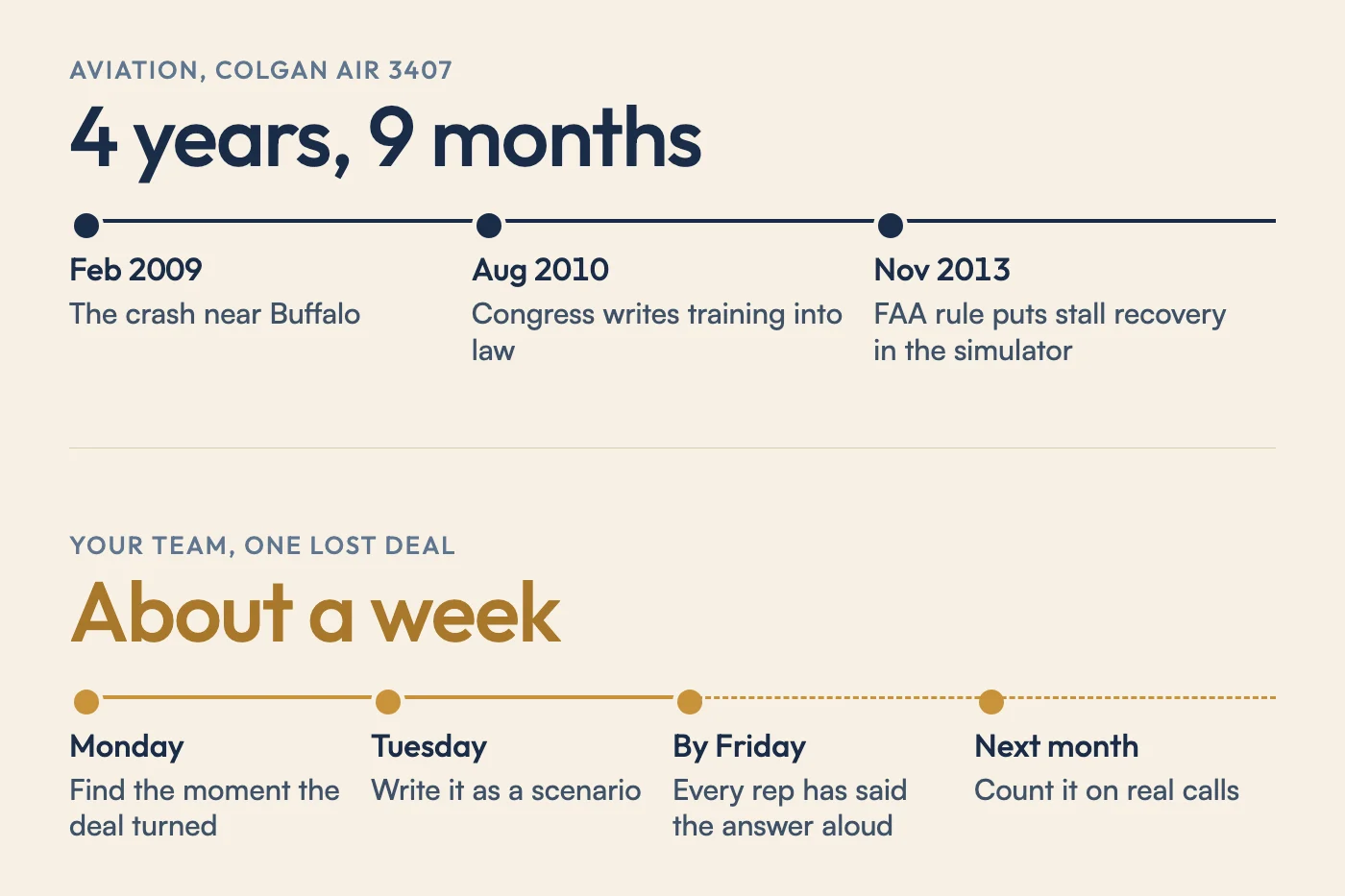
What makes aviation worth studying is the step after the recorder. In February 2009, Colgan Air Flight 3407 crashed near Buffalo after what investigators called an inappropriate response to a stall warning. The next year Congress wrote training requirements into law. In 2013 the FAA's final rule required stall and upset recovery training in simulators, in both qualification and recurrent curriculums, with the Colgan crash named as part of the reason.
One failure on one evening became a drill for airline crews across the country. It took more than four years, and it was worth it.
Aviation needed an act of Congress. You need a Tuesday afternoon.
Here is the same machinery laid out side by side. Most sales teams own the first row and improvise the rest.
| In aviation | What it does | In sales |
|---|---|---|
| Flight recorder | Captures what actually happened | Call recording |
| Accident investigation | Works out why, and writes it down | Deal review, when it happens at all |
| Mandated simulator scenario | Turns one failure into everyone's drill | A practice scenario built from a lost deal |
| Check ride | Proves the skill before responsibility is handed over | Certification before a rep owns a stage of the deal |
| Instructor in the seat | Supplies the judgement the machine lacks | A manager who coaches from evidence |
There is one more thing the simulator did for aviation, and it is the part we find most striking. In a 1979 NASA study, H. P. Ruffell Smith ran airline crews through a full simulated mission and watched. Error counts varied widely between crews, and differences in decisions seemed tied to how well captains managed the resources on the flight deck. That same year NASA held the first workshop on what became crew resource management, and United Airlines built a training programme out of it.
An industry that had every reason to think its problem was hands on controls found that a good part of it was people talking to each other. It took a simulator to see that. Sales has always known its job is conversation. It has rarely had a place to study one under pressure.
#Three things worth copying
#Rehearse what you cannot afford to meet for the first time live
Simulators are not mainly for routine flying. They are for the moments a crew may meet rarely, with the highest cost if they get it wrong.
Most sales practice runs the other way, drilling the pitch a rep already gives ten times a week. The better question for a practice plan is which moments are rare, expensive and impossible to redo. That list usually includes the CFO who joins the last call unannounced, the procurement lead who asks for the discount your rep is not allowed to give, and the champion who says the project has been paused.
In Revyn Voice, the buyer can stall, go quiet, put you on hold or hand you to a gatekeeper, so a rep can have the bad version of the call on a Wednesday afternoon, when it costs nothing.
#Connect the failure to the drill
This is the step most teams skip, and the one where sales has an unfair advantage over aviation, because nothing needs to go through a regulator.
Revyn is built around this link. Objection intelligence mines the objections raised on your imported calls. Objection to loss ranks them by the deals they were on and the win rate when they appeared, and a manager can promote the worst one into the knowledge base and a drafted scenario. The thing that lost a real deal this month becomes what the team practises next week. Trackers then count whether that moment is still appearing on real calls, and practice and real calls are graded on one scale, so you can check if anything actually moved.
#Make practice a gate, not a gym
Here is the fact that surprises most people outside aviation. Under zero flight time training, a qualified pilot can complete an entire type rating in a simulator before ever flying that aircraft. Rules vary by regulator and the conditions are strict. Fiji's guidance, for example, asks for the highest qualified class of simulator, a dedicated session of at least six take-offs and landings, and an instructor supervising the first four in the real aircraft.
An industry this careful has decided that a well-built simulator can carry real weight as evidence of readiness. Most sales organisations treat practice as optional fitness. Reps go if they have time, and readiness remains a manager's feeling.
A Revyn certification sets a visible bar on a skill, such as handling the security objection at level three with an average above 80 across three calls. Clear it and you take that part of the deal alone. Readiness to outcome then checks the bar against what really happened to deals. If ready reps do not win more, the bar is wrong, and you change it.
#The simulator that helped cause a crash
An honest case for simulators has to include this part.
On 12 November 2001, American Airlines Flight 587 lost its tail shortly after take-off from JFK and crashed in Queens, killing 265 people. The NTSB found that the first officer's excessive rudder inputs broke the tail away, and it named two contributing factors: the A300's rudder system design and elements of the airline's own advanced training programme.
One simulator exercise rolled the aircraft past 90 degrees after an implied wake turbulence encounter. To make sure the aircraft got there, the flight controls were made ineffective for up to ten seconds at the start, and pilots were not told. The Board concluded the exercise could have left the first officer with "an unrealistic and exaggerated view" of wake turbulence, and with techniques that would behave very differently in a real aircraft.
A simulator teaches whatever it rewards, accurate or not, and the trainee carries that into the real thing with full confidence. Pilots call it negative training, and sales practice is full of it. A buyer that gives in because the rep sounded confident teaches confidence as a closing technique. A score that rises with word count teaches monologues. A persona still quoting last year's pricing teaches last year's deal.
This is why the unglamorous parts of Revyn matter most to us. A language model proposes evidence, and a deterministic rules layer decides what it is worth. Scores cannot be charmed. Framework credit needs a quoted line from the transcript. Some misses, like a call with no next step, cap the score regardless of how well the rest went. Your knowledge base separates what a buyer may know from what stays rep-only, so the simulated buyer never knows your discount floor.
None of that makes a simulated buyer a real one. Even the best full flight simulators, one regulator notes, still leave "perceptible" gaps with the real aircraft. Ours cannot reproduce a committee's politics or a champion who disappears for two weeks, and a stale knowledge base will produce a stale buyer. So here are five tests we would apply to any sales simulator, including ours:
- Go off-script. Does the buyer stay coherent, or fall back to its lines?
- Sound great and say nothing. Does the score go up anyway?
- Try to charm your way to a meeting. Can a rep get a yes that a real buyer would never give?
- Ask where a claim came from. Can you see which document the buyer was drawing on?
- Compare to reality. Are practice and real calls graded on one scale, so you can tell whether the simulator predicts anything?
#Keep the instructor in the seat
The strongest evidence on AI coaching in sales points the same way aviation does. In randomised field experiments published in the Journal of Marketing, Luo and colleagues assigned 429 fintech sales agents to an AI or human coach. Mid-ranked agents improved most with AI. Bottom-ranked agents were swamped by the volume of feedback, and top-ranked agents resisted it. In a later experiment, the AI and human combination beat either one alone.
That study is about coaching software in general, not roleplay, and it comes from one industry. Still, the design lesson is clear, and it matches the Fijian rulebook, which puts the instructor in one of the pilot seats during that final simulator session. The machine supplies repetitions and data. A person decides what they mean for this rep, this week.
That is how we think about the manager's role. Revyn is there to give them a readiness view and a shortlist of the moments worth their time, so their coaching hour starts from evidence. Replacing them was never the point.
#What to do this week
You can run this without buying anything.
- Pull your last ten lost deals and listen for the turn: the exchange where the deal stopped moving. It is rarely the one in the CRM.
- Name the moment that recurs most. One moment, in the buyer's words.
- Write it down as a scenario. Who is speaking, what they say, what a good answer does, and what is not acceptable.
- Have every rep say the answer out loud at least three times, with a manager or a tool playing the buyer.
- Count that moment on next month's real calls. If nothing changes, the drill was wrong or the diagnosis was. Both are useful to know.
Do this once by hand and you will see why it does not stay done. Finding the moment takes hours of listening, and a manager cannot play the buyer for twelve reps. That gap is the reason Revyn exists.
#The short version
- The flight simulator did not win on technology. It won when the cost of learning in the real aircraft became visible.
- Sales failure is quiet, so the cost of reps learning on live buyers never reaches a budget.
- Recording is half of a system. The value comes from turning what you find into practice, and sales can do that in days.
- Rehearse the rare, expensive moments, connect each failure to a drill, and make practice a gate.
- A bad simulator is worse than none. Test what yours rewards, and keep a human instructor involved.
Sales will never get a single 1934, with a hearing and a headline to force the decision. Somewhere on your team, a rep is about to meet your hardest objection for the first time, in front of the buyer who matters most. Nothing will make you change that. You will have to decide to.
#FAQs
What is sales simulation training?
Sales simulation training puts a rep in a realistic practice conversation with a simulated buyer, usually AI voice today, and scores it. The rep can get a hard moment wrong and repeat it with no deal at risk, in the same way a pilot rehearses an emergency in a flight simulator.
Can AI roleplay replace a sales manager's coaching?
No. In randomised field experiments published in the Journal of Marketing, a combination of AI and human coaching beat either alone. AI supplies repetition and data, and a manager supplies judgement about the individual rep.
What is negative training in sales?
Negative training is practice that teaches the wrong behaviour because the simulator rewards it. A roleplay buyer who agrees because a rep sounded confident is the common sales example. The term comes from aviation, where inaccurate simulator exercises have been linked to real accidents.
How do you turn a lost deal into a practice scenario?
Find the exchange where the deal stopped moving, write it in the buyer's words, define what a good response does, and have reps answer it out loud. Then track whether that moment changes on real calls. Revyn does this by mining objections from imported calls into drafted scenarios.
How often should sales reps practise?
There is no proven number. A more useful target is a visible bar: a rep practises a specific moment until they clear a defined score across several attempts, before they meet it on a live deal.
Give your next rep their first landing before the live one.
Start freeMore from the blog
Best AI Sales Roleplay Tools in 2026: Why Teams Pick Revyn
Most AI sales roleplay tools do one thing well. Revyn covers realistic practice, real-call scoring, coaching, certification and Indian languages in one place.